
Software isn't dead, it just started working!
Software as an Employee is the only future that matters
A few months ago, we wrote about the coming SaaSpocalypse, predicting the death of the per-seat model and the inevitable shift toward outcome-based software. Last week, many people asked me if this is happening faster than expected. The answer is a resounding YES… A +€20k monthly LLM bill from Claude, Gemini, or OpenAI isn't a hosting cost. It is your new payroll.

We are moving past simple automation into an era where persistent, goal-oriented AI systems redefine the very core of business operations. The recent stock market corrections are just a real-time repricing of seat-based software. Wall Street is waking up to the fact that paying for "access" is a legacy model. The future belongs to outcomes, where you pay for measurable value delivered, not licenses consumed. We are moving from Software as a Service (SaaS) to Software as an Employee.
The industrialisation of code
This mutation is driven by a counter-intuitive truth: The cost of code is collapsing.
AI systems can now write, test, and deploy software with minimal human intervention. While maintenance and complex logic still require investment, the initial barrier to build is now incredibly low. On top of this, new open-source autonomous agent frameworks like OpenClaw allow LLMs to execute real-world tasks across messaging apps, file systems, and APIs while you sleep.
But here is the paradox: Instead of democratising software, AI is concentrating power. When anyone can generate code, the "creation" is no longer the differentiator. Value shifts toward the "Factory" - the infrastructure that can produce reliable results at scale. The winners will be those who operate large-scale software factories with built-in compliance and trust mechanisms, allowing software to ship safely at machine speed in different vertical markets.
The symphony of execution: three core actors
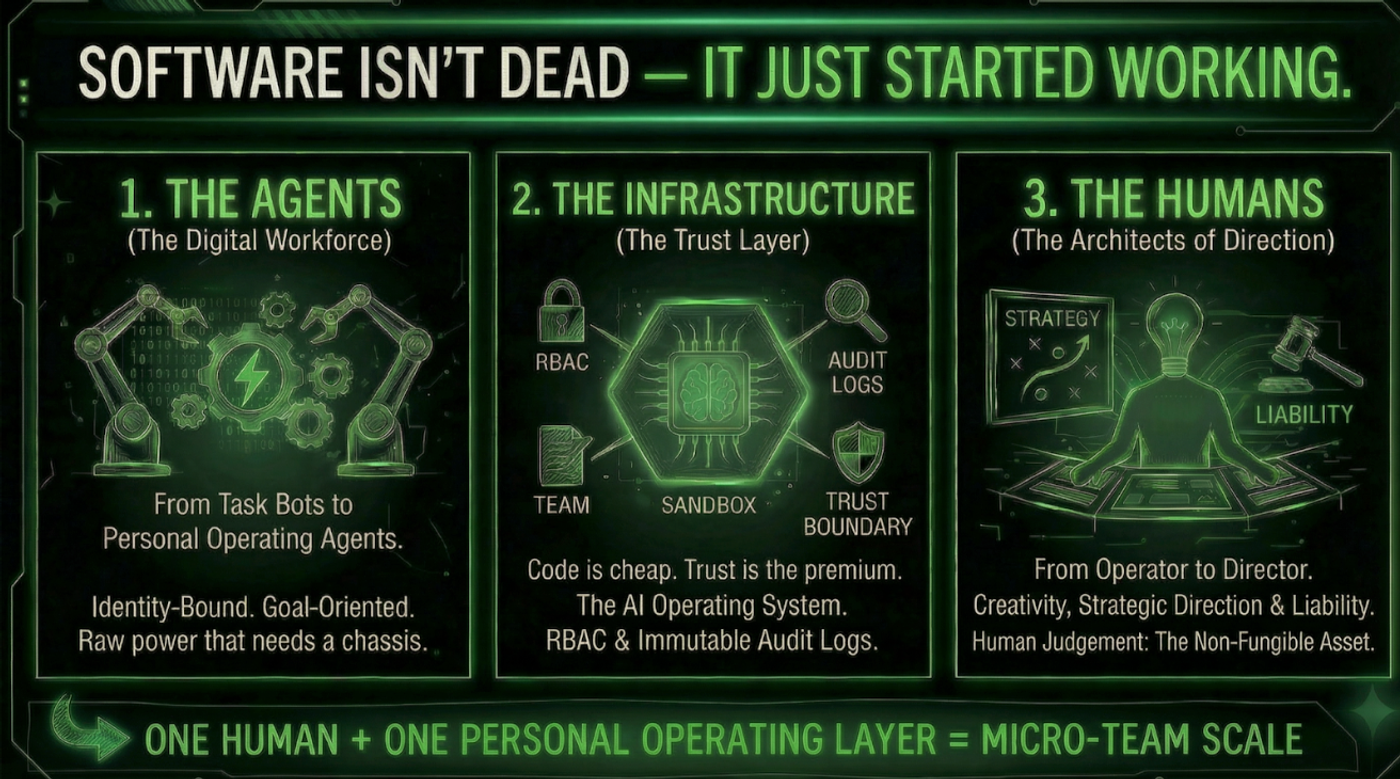
To run these new software factories, we need a new organisational chart. It requires three distinct actors working in harmony:
1. THE AGENTS (The Digital Workforce): These are the muscles. We have moved from narrow "Task Bots" to persistent, goal-oriented Personal Operating Agents. An operating agent is identity-bound; it doesn't just perform a task, it executes your personal operating logic and momentum. Good examples are solutions like OpenClaw, still very raw, but powerful glimpses of the future. Like any high-performance engine, they require a chassis - a governed environment of security, permissions, and audit logs - to stay on the road and deliver results safely.
2. THE INFRASTRUCTURE (The Trust Layer): If code is cheap, Trust is the premium. This is the AI Operating System that manages the friction between agents and ensures compliance. The real moat for companies today is building isolated, horizontal and vertical execution environments with robust Role-Based Access Control (RBAC) and immutable audit logs. This layer ensures the factory runs at machine speed without burning down the house.
3. THE HUMANS (The Architects of Direction): In a world of infinite digital labor, the human role shifts from Operator to Director. An agent can execute, but only a human can inject creativity, provide strategic direction, and, crucially, take liability for the outcome. Human judgement becomes the only truly non-fungible asset.
A DeepFlow moment: why infrastructure is the moat
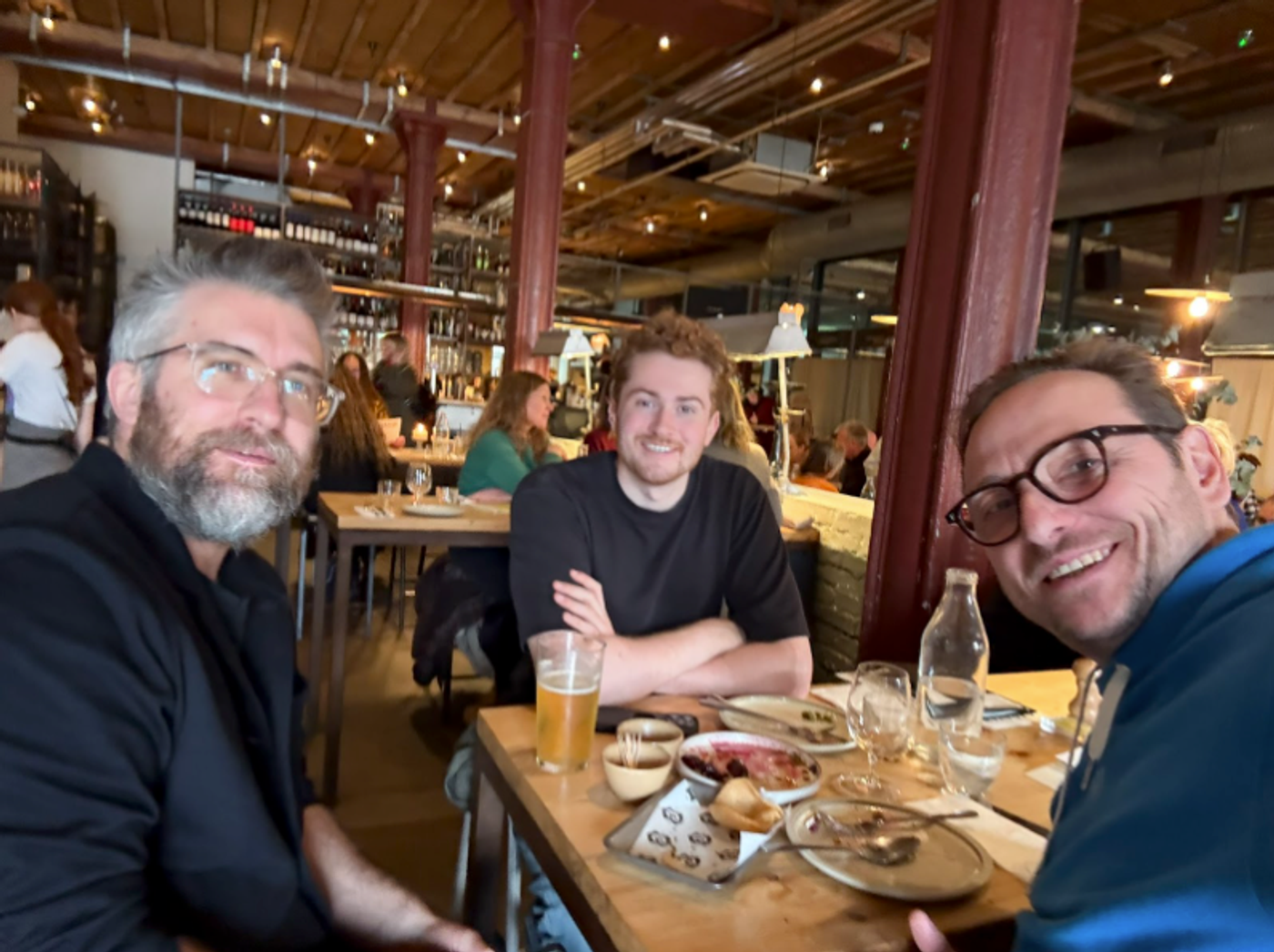
This isn’t theoretical. The absolute necessity of this orchestration layer is why we invested in DeepFlow, a London-based portfolio company. DeepFlow provides a human-agentic orchestration platform that connects and manages the work of human employees and AI agents in a single, auditable system. It’s designed to solve the exact problem of building and scaling a trusted digital workforce.
Their solution became tangible in a recent real-world crisis when I was visiting the founders from DeepFlow, Alastair & Jonathan 2 weeks ago in London. On that day, February 10, 2026, an urgent question was raised in the British Parliament regarding the Ministry of Justice ordering the deletion of the UK's largest court reporting data archive, run by a company called Courtsdesk, and powered by DeepFlow. The government cited a data breach, alleging that Courtsdesk had shared sensitive information with a third-party AI company, creating a firestorm around the principles of open justice and data security. Crucially, 750,000 posts, 192,000 petition signatures, and a pinned tweet from Elon Musk later, it is clear that DeepFlow’s infrastructure has become essential to a system of national importance.
This event highlights the critical fragility of our digital public infrastructure. When the digital twin of a legal system is under pressure, "craftsman" code is not enough. What is required is industrialised trust: an infrastructure built for auditability, control, and resilience. This is precisely the orchestration layer DeepFlow provides - a system that allows companies like Court Data Solutions (the enterprise client behind Courtsdesk) to innovate with AI while maintaining the rigorous governance and immutable logs necessary to operate in high-stakes environments like legal reporting. When your digital employees are handling sensitive data, the infrastructure of truth is the only moat that matters.
The unit economics of the "Sovereign Founder"
At Pitchdrive, we are living this new Operator Agent wave. We are actively deploying multiple personal Agent Operators in parallel that handle internal VC tasks 24/7, fully orchestrated.
Across our portfolio, we are seeing a structural reset in unit economics, marked by extreme growth of minimum +20% month over month, but lower margins compared to traditional SaaS.
Traditional SaaS lived in a world of 80% gross margins. In the Agentic era, every outcome burns tokens. We are seeing companies grow at lightning speed while operating at 30% gross margins. On paper, this looks "worse." In reality, it is a massive upgrade.
The high LLM infrastructure cost is replacing the much higher cost of human labor.
We are entering the era of the "Sovereign Founder," where a single founder or micro-founding teams utilising the best of Claude, Gemini, and GPT can outperform a legacy competitor with 50 employees.
Just a glimpse of some Pitchdrive portfolio companies illustrating this shift of high growth in the last weeks (this is just a selection, we could easily list +20 other portfolio startups witnessing this moment):
1. Axe AI (Dublin): The Voice Dispatcher That Doesn’t Sleep. In the logistics industry, the bottleneck is the "human switchboard" of dispatchers coordinating freight. Axe AI has built autonomous voice agents that don’t just "transcribe"; they book shipments, provide ETAs, and update systems. They are replacing the need for massive dispatch centers, trading high-cost salaries for 24/7 LLM-driven agents.
2. Conveo.ai (Antwerp): 24/7 AI-Led Market Research. Traditional qualitative research requires weeks for recruitment, moderation, and analysis. Conveo has developed an autonomous "AI coworker" that conducts voice and video interviews in parallel, using research-grade logic to probe for depth. They are reducing time-to-insight from weeks to days and cutting research costs by 75%, completely bypassing the need for manual transcription and coding.
3. Introw (Ghent): The AI-Powered Partner Architect. In B2B, partnerships often die in the "spreadsheet graveyard" because human partner managers can't keep up. Introw has built a CRM-first AI platform that onboards, trains, and activates partners in minutes. Their AI agent acts as a 24/7 support and sales coach for thousands of external partners, automating the "middleman" work of deal registration and enablement that used to require an entire department.
4. Gro.app (Stockholm): AI That Turns Brand Data into High-Converting Ads. In the beginning of a startup, revenue growth used to be a steady climb. With Gro.app, we witnessed a massive growth rate of €500k ARR in their first week after launching. In the traditional world, that’s a big celebration. In the Agentic world, it’s a baseline. When you stop being limited by human "work hours," the growth curve looks like a vertical line.
Leveraging your new digital workforce
A natural question arises: What happens to the people whose seats are replaced by LLM credits?
While the shift is disruptive, it contains a profound opportunity. For decades, millions of talented people have acted as "human middleware"- spending their days copy-pasting data, manually coordinating schedules, and performing "click-work" that machines were simply too dumb to handle.
The Agentic Era marks the end of administrative drudgery. When we replace €500k in total salary with a €20k LLM bill, we aren't just saving money; we are liberating human cognitive capacity. The people who thrive in this new economy will be those who transition from doing the work to defining the work.
- The "Generalist" becomes a "General": Every individual now has the power to command a department-sized workforce.
- Creativity is the new Technical Skill: When the cost of execution drops to zero, the value of a unique, creative vision skyrockets.
- The Sovereign Career: We are moving toward a world of "Companies of One" that carry the weight of "Companies of One Hundred."
This new economy isn't just about digital efficiency; it also bridges the gap between AI-driven strategies and physical world impact, enabling lean teams to materialise complex products and services in record time in both worlds, thereby unlocking unprecedented opportunities for many people.
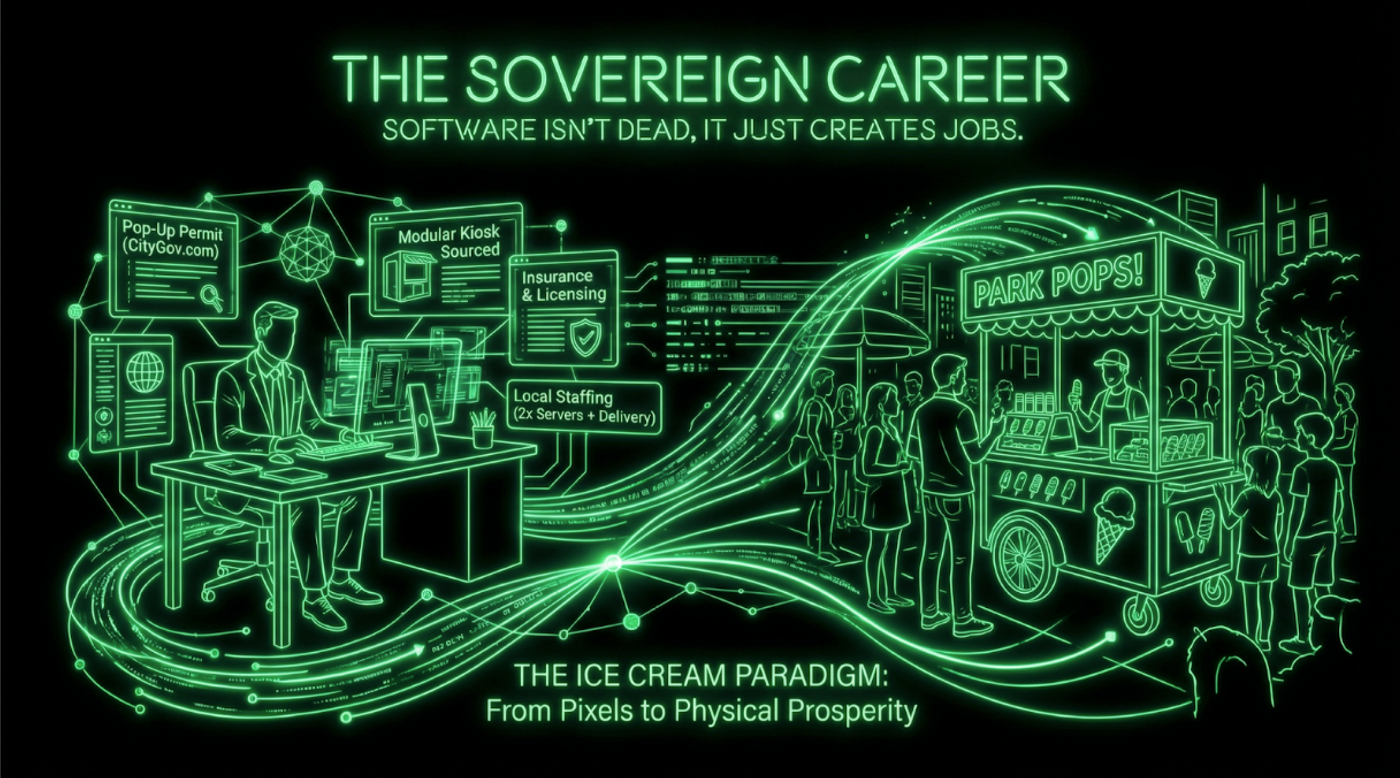
The "Ice Cream Bar" paradigm: materialising a new economy 🍦🚀
The Sovereign Career isn't just about moving data; it’s about the power of a "Company of One" to materialise physical businesses and offline jobs in record time. I expect the following scenario to be possible in the coming year(s)...
Imagine you’re in a park during a heatwave. You spot a gap and see hundreds of people and zero refreshments. In the old world, you'd just wish you had an ice cream. In the Agentic era, you orchestrate a local economy into existence:
- The Opportunity: You identify the gap and the "weather window."
- The Execution: You deploy your Operator Agents. One agent navigates the local municipal portal to identify if apop-up permit is needed and files the application autonomously.
- The "Offline" Ripple Effect: Your agents don't just "buy" things; they trigger a local supply chain.
- They contract a specialised delivery business to transport a modular kiosk.
- They hire an on-site service person to manage the stand and a cashier for the peak hours.
- They even spin up a quality control agent to monitor sales data and local hygiene compliance in real-time.
- The Orchestration: Using tools like Deepflow, you synchronise the suppliers, the local staff, and the logistics.
The Result: Within 48 hours, a fully compliant, branded ice cream business is live. You are The Catalyst. You aren't scooping ice cream or driving the truck; you sit at the top of a temporary, high-performance ecosystem.
Underneath your "Company of One," a new economy is born: you’ve created two weeks of high-value work for delivery drivers, service staff, and local dairy suppliers.
When the weather turns, the agents wind it down. You’ve captured the profit of the "weather window" and moved on to the next opportunity before the first rain cloud hits.
This is just one simple example of what the near future could look like: The digital "Catalyst" commanding a real-world workforce to solve physical needs instantly.
We need everyone on the boat: the institutional challenge
So yeah, the centralised "Factory" creates the positive consequence of the SaaSpocalypse: the democratization of scale. In the legacy world, only the wealthy and highly networked people could hire a staff of fifty to execute a vision. In 2026, by tapping into these massive software factories, anyone with the clarity to direct an agentic ecosystem can compete with a titan, in both the online and offline world.
However, this is not happening automatically. To avoid a deepening divide, we need a massive, coordinated effort to get everyone on the boat:
- Education Reform: Universities must move past teaching "how to use tools" to teaching "how to lead systems." We need to focus on orchestration, critical logic, and liability.
- Government Proactivity: Regulators must move at high speed to create the "Industrialised Trust" frameworks that allow small players to operate safely in both the digital and physical world .
- A Shift in Mindset: We must invest in reskilling the "middleware" generation, transforming them from executors into Architects of Intent.
The "Velocity Gap" is not just a threat to companies; it is a threat to societies. We cannot leave the transition to chance.
The moment to act is now!
I urge scaleups, enterprises, universities, governments, but also employees to stop waiting. The current “Operator Agent moment” is not like the "ChatGPT moment" in 2023 where you typed a prompt and waited for a response. This is much bigger. This is systemic orchestration. Persistent digital labor. Continuous execution.
We are indeed in the singularity like some AI Tech leaders are stating… Not as science fiction, but as an economic condition. Execution speed is no longer linear. Capability is no longer proportional to headcount. Advantage compounds at machine velocity
This is the new economic reality:
- Autonomy Boost: We are evolving from isolated prompting to systemic orchestration, empowering organisations to deploy coordinated agent ecosystems that deliver proactive, continuous machine-speed services.
- 10x Augmentation: Orchestrating these actors (Agent, Infrastructure and Humans) multiplies execution speed by an order of magnitude.
- The Hourly Rate Reset: Modern organisations will replace high-cost hourly labor with persistent vertical AI agent.
- Compounding Advantage: Organisations that restructure early will accelerate while others attempt to catch up.
If you are not actively experimenting with Agent Operator models today, you are not simply “behind”. You are structurally compounding disadvantage. We are leaving the era of software subscriptions. We are entering the era of digital payroll.
The future does not belong to those who casually use AI systems. It belongs to those who redesign their organization around them.
Employ the machine. Or compete against someone who does.